

November 13, 2026
AI can speed up the work. It can't replace what your team knows.
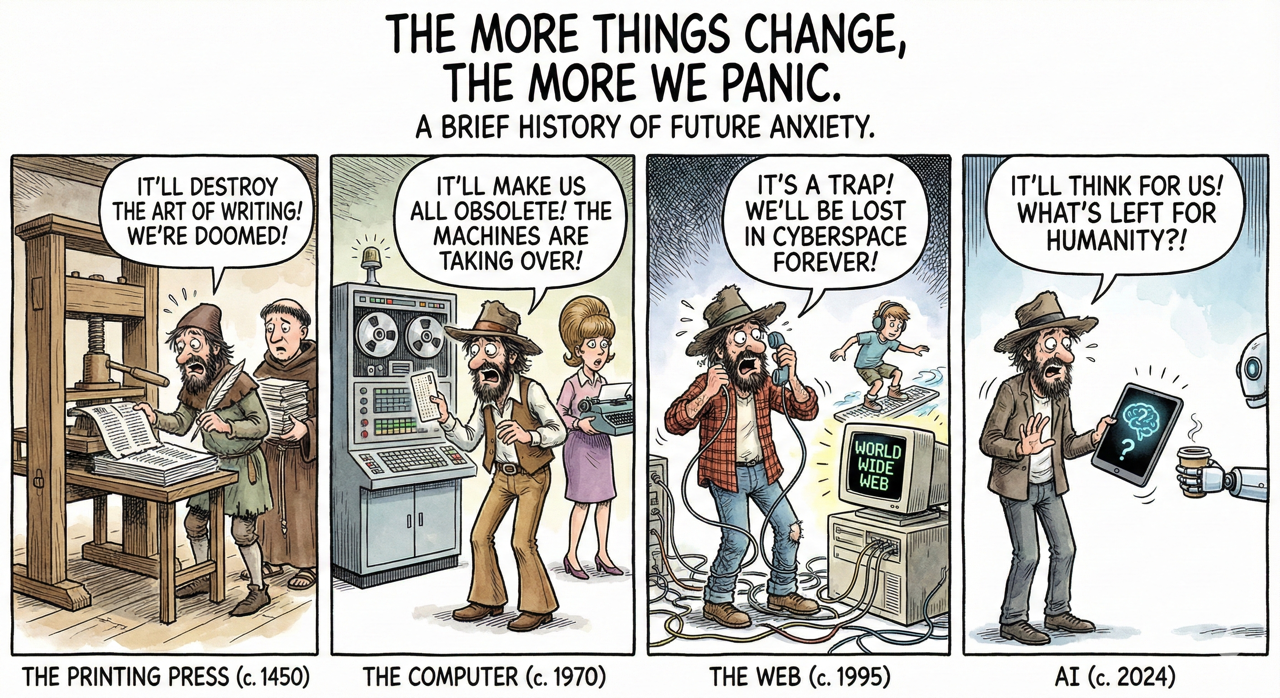
Every few years, a new tool arrives, and marketers hear that everything is about to change. We heard it with websites, then search, then social media, then marketing automation. Each one did change how we work. None of them removed the need to understand the people you sell to.
AI feels bigger, and in some ways it is. It moves faster than anything before it, and it touches almost every task on a marketer's desk. Still, the question we keep asking is the one we asked with every earlier shift: how can this tool help us build stronger human connections with our customers?
We've spent the past three years testing that question in our own work. Our CEO, Randal Hrytzak, shared early lessons at an IABC special interest group session in 2025, and we've since run hands-on AI workshops for our clients' marketing teams. Here's what we've learned.
Industrial technology buyers are engineers, operations leads and procurement teams. They read closely, they spot vague claims quickly, and they often research for months before talking to sales. Content earns their trust through accuracy and specifics.
AI makes plausible copy cheap. That's the problem. When anyone can produce 1,000 words on battery management or hydrogen fueling in under a minute, 1,000 words is worth less. What keeps its value is what generic tools can't produce: field experience from your engineers, the realities of your customers' operations and the trade-offs your team has seen first-hand.
So we hold a firm line. We don't use AI as a source of leadership or technical content. It isn't fully credible. It doesn't set you apart. It can be tone deaf, and even at its best it struggles to sound authentic.
Consumer brands offer a warning here. Coca-Cola's AI-generated holiday ads drew public backlash in 2024, and again in 2025. This year, Dior is facing backlash for seemingly using generative AI for video editing their holiday campaign (in contrast to Prada being praised for their transparency in using traditional hand-drawn illustration techniques).
If brands that size can lose goodwill that way, industrial brands that sell on trust should take note.
The better approach is to use AI around your expertise, not in place of it. We group our use into five types of work:
Here's an example of align and validate. We had built a messaging document for a biogas client, with an audience matrix, core promise, proof points and messaging pillars. Soon after, an industry association released public polling on how people view biogas. It found low name recognition for biogas, while renewable natural gas was far more familiar.
We gave the 36-slide polling deck to an AI tool and asked for a summary. A team member checked that summary against the slides. Then we shared our messaging document and asked where the new findings should change it. The tool returned a table of suggested edits by section. We reviewed each one and kept only what held up.
The AI saved us hours of cross-referencing. The judgment stayed with us.
On a film set, the director doesn't run every camera. They set the vision, make the calls and decide what makes the final cut. That's the role marketers are moving into. AI is the crew: fast, capable and completely dependent on direction.
Good direction starts with good prompts. Be specific. Set the intent and the audience, and don't assume the tool knows either one. Ask for a considered response instead of an agreeable one. Then reprompt. In our experience, the real gains come in the second and third rounds, not the first.
When we need structure, we use a simple model:
Directors also decide what stays off set. Keep proprietary data and confidential customer information out of public tools. Don't make critical business decisions from AI output alone. And watch for flattery, because many tools lean toward agreeing with you. Ask them to challenge your assumptions and weigh other views before they answer.
Most teams are past the first experiment. One person uses AI for meeting notes, another for social posts, and someone keeps a private prompt folder. That's progress. It isn't a system.
The bigger gains come from shared context. What the tool can see matters more than which tool you pick. Keep your messaging, product details and style rules in one workspace, so every prompt starts from the same facts. Then set team habits:
Then ask the question we started with. Does this help us connect with the people we serve? If not, change course.
We've been here before. The tools will keep changing. The need for clear thinking, real expertise and honest communication won't.
If you're working out where AI fits in your marketing, we'd be glad to compare notes. Contact us.


The inside-out agency.


